
![[personal profile]](https://www.dreamwidth.org/img/silk/identity/user.png)


"This could happen to you, baby! This could happen TO ANYBODY!"
When I heard that my Mystery Hunt team was to be named The Evil Midnight Bombers What Bomb at Midnight, I was very excited. The Evil Midnight Bomber What Bombs at Midnight is one of my favorite villains from the animated The Tick. In fact, the title of this entry was my "Exit Windows" sound for a while when I was in college. I didn't realize that it would also be a metaphor for our team: high explosives, low organization.
I just read a blog post by a member of Codex Dresden:
Still, the victory of The Evil Midnight Bombers What Bomb at Midnight is a tribute to the power of putting a score of smart people (the high explosives I mentioned earlier) in a room with no organization whatsoever. In the lull before the Hunt began, we sat around headquarters while our one of our team captains,![[livejournal.com profile]](https://www.dreamwidth.org/img/external/lj-userinfo.gif) thedan, gave us some lackadaisical instructions. As we pelted him with questions about how our team was going to run and how things would go, he generally shrugged, smiled shyly, and told us he didn't know and don't worry about it.
thedan, gave us some lackadaisical instructions. As we pelted him with questions about how our team was going to run and how things would go, he generally shrugged, smiled shyly, and told us he didn't know and don't worry about it.
There were a few things organized. Round answers would be put on chalkboards to aid metapuzzling. Answers were not to be spoken aloud, because a major competitor was on the other side of a hastily soundproofed door. And completed puzzles went into folders. The attitude of the captains was that the little things would take care of themselves, and that things like wikis were more trouble than they were worth.
During the Lobby 7 mingling, I spoke with a member of Setec Astronomy (thedan's former team) who asked how Dan was holding up under the stress. I said he looked a bit nervous, but mostly okay. My Setec friend (G Natural, for those in the know) said that he and his teammates had been trying to psych him out by saying things like, "Have you assigned round captains yet? You really need to have your round captains in advance." I told him that Dan seemed to be impervious to that much organization.
Maybe you can tell from my tone that I wasn't entirely comfortable with the level of unpreparation that we appeared to be approaching. (If you can't, I'll tell you now that I wasn't entirely comfortable with the level of unpreparation that we appeared to be approaching.) Still, I did have bigger things to worry about, like solving around a hundred puzzles, even though I felt that my skills were rusty.
Some things weren't wrong pretty badly. Our main phone died shortly after the Hunt started, and we had to get some cell phones together pretty quick. Other things went fantastically well.thedan and wesleyjenn made sure to enforce some sleep staggering, so we always had strong solvers working on puzzles (which was the main reason for our big lead through most of Saturday).
But in the long run, I think that "let the little things take care of themselves" ended up translating into "let the little things be taken care of by the people who are worried about the little things." Since I was one of the people who cared about things like where the spare copies of solved puzzles had gotten to, I ended up putting myself in charge of making sure that spare copies of solved puzzles got placed neatly into folders. And I do think this worked pretty well. It gave me something to do when I didn't feel like I had anything incredibly important to contribute to any open puzzle; it put my mind at ease about whether our disorganization would be our downfall; and it let everyone who didn't care about it get on with whatever they were doing. There are probably other little organizational things that someone else took care of that I didn't notice because I was busy with my folders and puzzles.
My round-folder maintenance later inspired me to create a fantastic endgame folder, which contained all of our answers and notes and artifacts in reasonably easy-to-read handwriting. And it was black and leather-looking, making it appropriately spyish. It's one of the things I'm most proud of from the Hunt. I think that captainwesleyjenn has it now. She'd better cherish it.
It turned out that organization wasn't very necessary; the team's biggest asset was being a bunch of people who are fun to be around. And that's important, because more than talking with people or working with people, during a Hunt, you're just around people. They're next to you, and you're borrowing their computers, and they're using your graph paper, and if you haven't met them before, you won't remember them until after you can get some sleep on Sunday. One of the great things about winning this Hunt is that the team is going to be together for the entire year, instead of disbanding by February and reforming sometime in late fall.
I just read a blog post by a member of Codex Dresden:
Most of the teams are distributed around the world, with a large contingent in person at MIT and others participating remotely over the Internet, usually co-ordinating their efforts via wikis, mailing lists, chats, etc. Sometimes teams will try to co-ordinate their sleep schedules so that they have team members somewhere in the world working on puzzles 24 hours a day until the hunt is over. A modern Mystery Hunt team may have 50 members, who may well be literal nuclear physicists, rocket scientists, etc.My response to this was, "Really?" It just may be team-experience bias; on Bombers and ACRONYM, I was always one of under 30 solvers with very few remote players, while Codex seems to have always been a big networked player. (As a member of the winning team, I guess I'll know whose impression is more correct, since I guess I'll be seeing the survey results eventually.)
Still, the victory of The Evil Midnight Bombers What Bomb at Midnight is a tribute to the power of putting a score of smart people (the high explosives I mentioned earlier) in a room with no organization whatsoever. In the lull before the Hunt began, we sat around headquarters while our one of our team captains,
thedan, gave us some lackadaisical instructions. As we pelted him with questions about how our team was going to run and how things would go, he generally shrugged, smiled shyly, and told us he didn't know and don't worry about it.There were a few things organized. Round answers would be put on chalkboards to aid metapuzzling. Answers were not to be spoken aloud, because a major competitor was on the other side of a hastily soundproofed door. And completed puzzles went into folders. The attitude of the captains was that the little things would take care of themselves, and that things like wikis were more trouble than they were worth.
During the Lobby 7 mingling, I spoke with a member of Setec Astronomy (
thedan's former team) who asked how Dan was holding up under the stress. I said he looked a bit nervous, but mostly okay. My Setec friend (G Natural, for those in the know) said that he and his teammates had been trying to psych him out by saying things like, "Have you assigned round captains yet? You really need to have your round captains in advance." I told him that Dan seemed to be impervious to that much organization.Maybe you can tell from my tone that I wasn't entirely comfortable with the level of unpreparation that we appeared to be approaching. (If you can't, I'll tell you now that I wasn't entirely comfortable with the level of unpreparation that we appeared to be approaching.) Still, I did have bigger things to worry about, like solving around a hundred puzzles, even though I felt that my skills were rusty.
Some things weren't wrong pretty badly. Our main phone died shortly after the Hunt started, and we had to get some cell phones together pretty quick. Other things went fantastically well.
thedan and wesleyjenn made sure to enforce some sleep staggering, so we always had strong solvers working on puzzles (which was the main reason for our big lead through most of Saturday).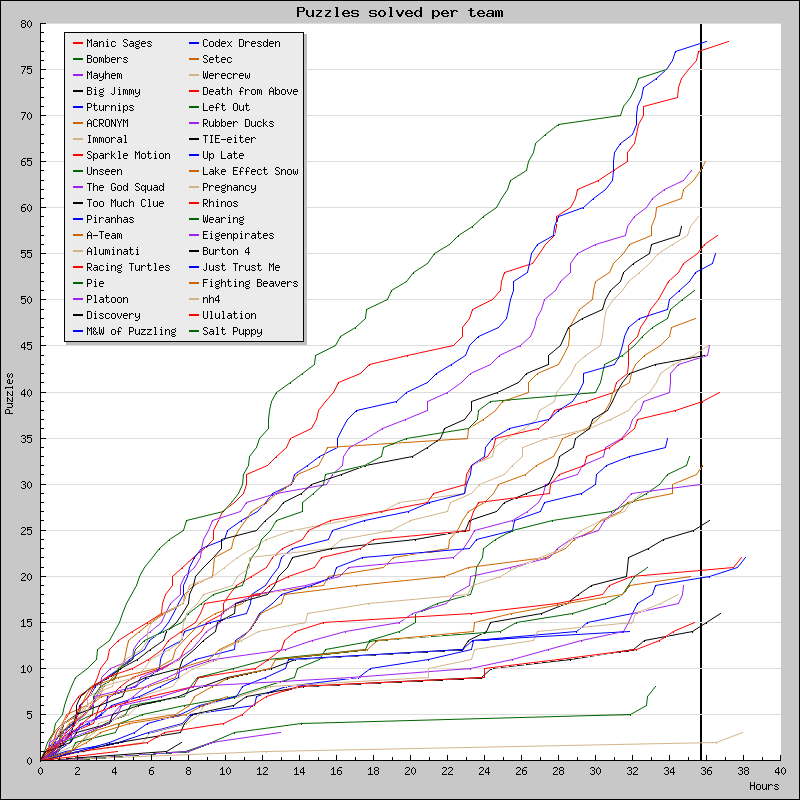
But in the long run, I think that "let the little things take care of themselves" ended up translating into "let the little things be taken care of by the people who are worried about the little things." Since I was one of the people who cared about things like where the spare copies of solved puzzles had gotten to, I ended up putting myself in charge of making sure that spare copies of solved puzzles got placed neatly into folders. And I do think this worked pretty well. It gave me something to do when I didn't feel like I had anything incredibly important to contribute to any open puzzle; it put my mind at ease about whether our disorganization would be our downfall; and it let everyone who didn't care about it get on with whatever they were doing. There are probably other little organizational things that someone else took care of that I didn't notice because I was busy with my folders and puzzles.
My round-folder maintenance later inspired me to create a fantastic endgame folder, which contained all of our answers and notes and artifacts in reasonably easy-to-read handwriting. And it was black and leather-looking, making it appropriately spyish. It's one of the things I'm most proud of from the Hunt. I think that captain
wesleyjenn has it now. She'd better cherish it.It turned out that organization wasn't very necessary; the team's biggest asset was being a bunch of people who are fun to be around. And that's important, because more than talking with people or working with people, during a Hunt, you're just around people. They're next to you, and you're borrowing their computers, and they're using your graph paper, and if you haven't met them before, you won't remember them until after you can get some sleep on Sunday. One of the great things about winning this Hunt is that the team is going to be together for the entire year, instead of disbanding by February and reforming sometime in late fall.
no subject
I wrote my first puzzle these last few days. Word. :)
no subject
no subject
It's one thing if you have someone who likes keeping track of stuff and volunteers to do it. (Especially if it's someone like me, who can be easily spared from puzzle-solving because I suck at it anyways. :)) But if you don't have anyone who's committed to systems maintenance, no organizational system will survive the first round of puzzles.
(btw, it's completely true that if you don't have remote solvers, a wiki is more trouble than it's worth. None of us, even I, would have bothered updating the ACRONYM wiki in realtime if we hadn't keenly felt our responsibilities to our offsite co-solvers.)
no subject